[ << 작업 목록으로 ]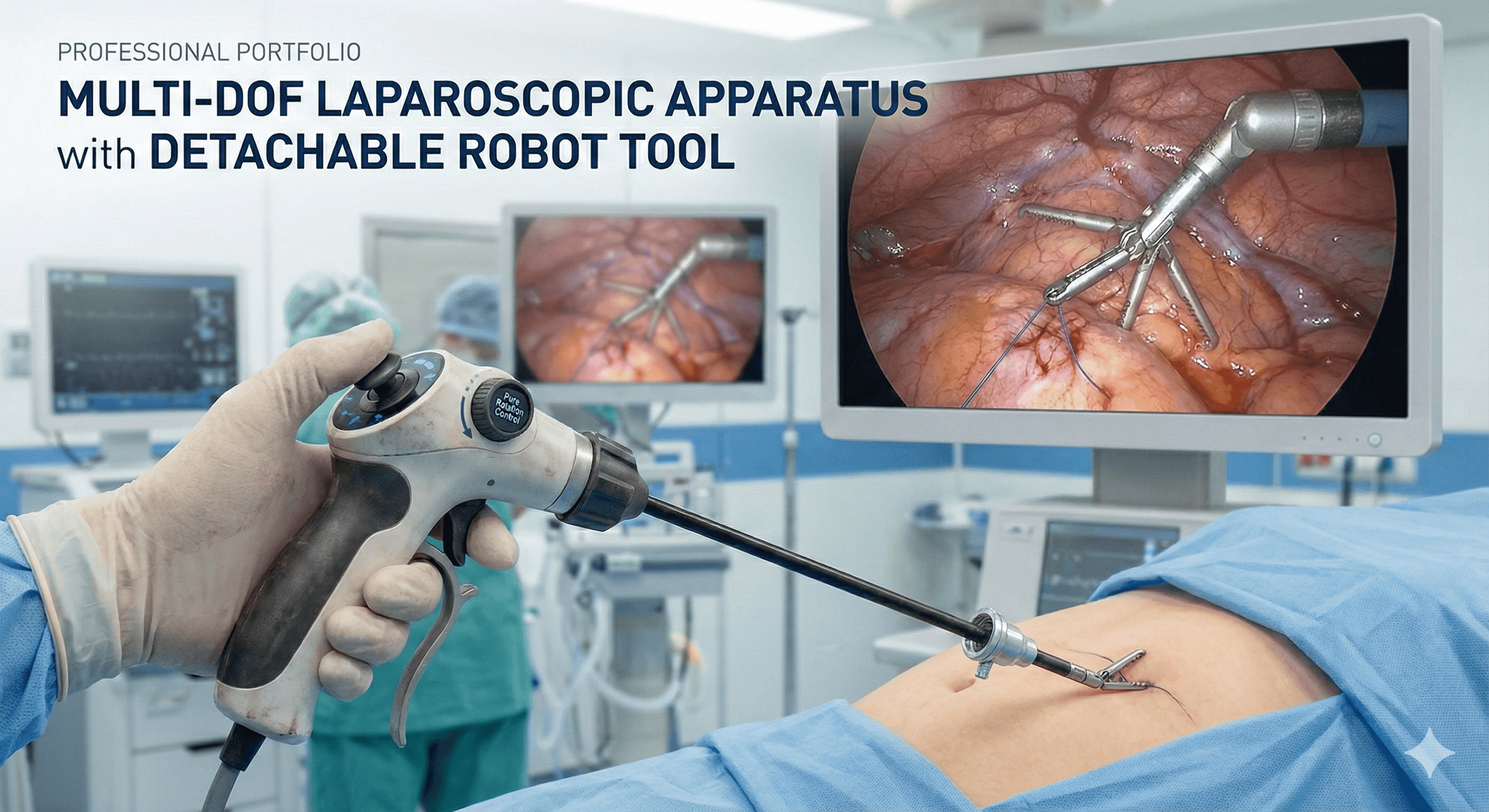
PROJECT_ID: 0017
Laparoscopic Surgical Robot
분리형 로봇 툴을 갖춘 핸드헬드 복강경 수술 장치(특허 KR102199910B1)를 개발한 프로젝트입니다.
분류
Medical Robotics
기간
2021.01
모듈 / 스택
- 01Embedded C
- 02Real-time Control
- 03Kinematics Algorithm
- 04Servo Motor Control
- 05Sensor Fusion
엔지니어링 스펙 시트
01 >> 문제 정의
도구가 굽혀진 상태에서도 ‘순수 회전’이 가능해야 했고, 와이어 구동 기구학을 소형 폼팩터에 구현해야 했습니다.
02 >> 해결 설계
4개 서보를 동기화하는 제어 알고리즘과 입력 장치(조이스틱/다이얼/홀 센서)를 통합하고, 와이어 장력 히스테리시스 보정을 적용했습니다.
검증된 결과
Patent registration is publicly verifiable through a patent database entry.
증빙 자료
CONFIDENTIAL // ENGINEERING_REPORT
AUTHORIZED_PERSONNEL_ONLY
상세 리포트
1. Invention Overview
-
Invention Title: Multi-DOF Laparoscopic Surgical Device using Detachable Robot Surgical Tools (KR102199910B1)
-
Problem:
- Existing manual laparoscopic tools lack degrees of freedom (cannot bend up/down/left/right, only simple rotation), making precise surgery difficult.
- In existing tools, bending and rotation are mechanically linked, making it impossible to implement 'Pure Rotation' where the tool rotates only axially while bent.
-
Solution:
- Developed a handheld device that incorporates servo motors and a control board in the main body, converting user operations (joystick, dial, trigger) into electrical signals to control the robot surgical tool (end-effector) with multiple degrees of freedom.
- Adopted a structure that allows existing robotic surgical tools (e.g., Intuitive Surgical) to be detached and reused.
-
Patent Status & Timeline:
- Status: Active (Anticipated expiration: 2038-09-12)
- Application Filed: 2018-09-12 (Priority to KR1020180108768A)
- Publication: 2020-03-20 (KR20200030209A)
- Granted: 2021-01-07 (KR102199910B1)
2. Key Technical Competencies
A. Embedded Control System Design
- Input Interface Processing: Process various sensor signals from joystick (up/down/left/right bending), rotary dial/encoder (axial rotation), and trigger/Hall sensor (gripper open/close) into control inputs.
- Multi-Axis Motor Control: Precisely drive the end-effector of the wire-driven robot tool by controlling 4 servo motors individually and in coordination.
B. Robotics Kinematics & Algorithm
- Pure Rotation Algorithm: Implemented an algorithm that controls bending motors and rotation motors in real-time synchronization so that the end-effector rotates only axially in place without bending or snapping even when the joint is bent.
- Kinematic Compensation: Applied control logic to compensate for hysteresis or mechanical interference by calculating the pulley rotation angle according to wire length.
3. Detailed Description & Implementation
① Hardware Configuration & Mechanism
- Detachable Structure: Designed to allow various types of robot surgical tools (wrist joint type, continuous joint type, etc.) to be interchangeably mounted via the mounting part on top of the main body.
- Input Device Mapping:
- Joystick: Up/Down/Left/Right operation → 2-axis bending (Pitch/Yaw) control of end-effector.
- Rotary Dial & Encoder: Dial rotation → Roll direction rotation control of end-effector.
- Trigger & Magnetic/Hall Sensor: Trigger pull detection → Open/Close control of end-effector (gripper).
② Core Control Algorithm (Claim-based)
- Independent Joint Control: Unlike mechanically linked existing tools, the control algorithm receives encoder and joystick signals and controls corresponding servo motors independently yet organically.
- Precise Synchronized Control (Pure Rotation Implementation):
- When the user rotates the dial while the tool tip is bent by the joystick, the system does not just rotate the rotation motor but also compensates and controls the bending motor.
- This adjusts wire tension to implement high-difficulty motion where the tool performs only axial rotation while maintaining the bent angle without straightening or twisting.
4. References & Links
- Patent Information (Google Patents): KR102199910B1 - Multi-DOF Laparoscopic Surgical Device↗