[ << 작업 목록으로 ]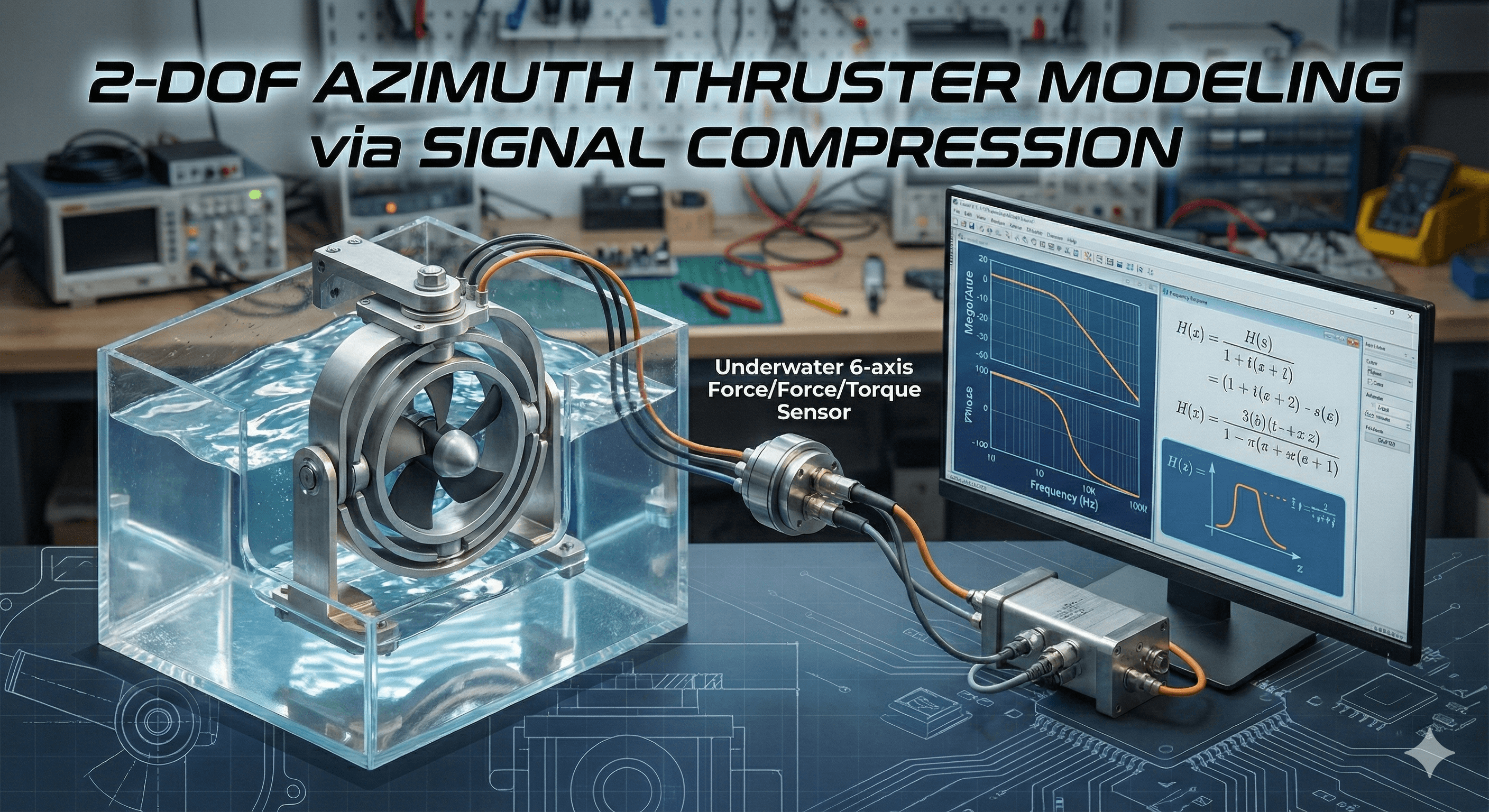
PROJECT_ID: 0016
2-DOF Azimuth Thruster
복잡한 유체역학 환경에서 2자유도 애지머스 추진기의 전달함수를 추정하기 위해 실험 기반 수학 모델을 구축한 연구 프로젝트입니다.
분류
Marine Robotics
기간
2020.08
모듈 / 스택
- 01NI Compact RIO
- 02LabVIEW
- 03MATLAB
- 04Signal Compression Method
- 05System Identification
엔지니어링 스펙 시트
01 >> 문제 정의
주파수 응답 실험만으로는 고주파 데이터 확보가 어려웠고, 짐벌 구조로 인한 비선형 진동/오버슈트가 존재했습니다.
02 >> 해결 설계
신호압축법(SCM)과 동특성 보정을 결합해 선형/비선형 성분을 분리하고, 최적화 기반 곡선 피팅으로 모델을 추정했습니다.
검증된 결과
Research output is publicly documented through paper artifacts and an external academic index entry.
증빙 자료
CONFIDENTIAL // ENGINEERING_REPORT
AUTHORIZED_PERSONNEL_ONLY
상세 리포트
1. Background & Problem Definition
- Project Name: Empirical Modeling of 2-DOF Azimuth Thruster based on Signal Compression Method
- Research Necessity:
- Existing underwater robots use multiple fixed thrusters, resulting in large volume and weight. To solve this, a 2-DOF Gimbal Mechanism capable of changing direction with a single thruster is needed.
- Underwater propulsion systems have complex hydrodynamic characteristics, making Analytical Modeling extremely difficult.
- Traditional frequency response experiments struggle to obtain high-frequency data, limiting the establishment of precise control models.
- Core Objective: Derive an Empirical Mathematical Model covering the entire frequency range (low to high) through actual hardware experiments.
2. Deep Dive into Technologies
A. Mechatronics Hardware Engineering
- 2-DOF Gimbal Mechanism Design:
- Designed a structure that freely controls the thrust direction using two servo motors (Yaw, Pitch).
- Manufactured and mounted a Counter Mass with the same shape and mass (1.35kg) as the servo motor to resolve center of gravity imbalance.
- Underwater Waterproofing Solution:
- Applied O-rings to all fastening parts and used Rotary Seals on rotating shafts to block fluid ingress.
- Applied Cable Glands to prevent water intrusion into motor wires.
- Electronic Component Configuration:
- Thruster: Maxon MI60 (Max Thrust 7kgf, Rated 24V).
- Controller: NI Compact RIO 9049 (Real-time Controller).
- Sensor: 6-axis F/T sensor (ROBOTUS RFT80-6A01) placed at the top to measure reaction force and moment.
B. System Identification & Signal Processing
- Signal Compression Method (SCM) Application:
- Principle: Based on the theory that applying an impulse signal to a system reveals the entire frequency response, but uses an Equivalent Impulse Signal instead of an actual impulse to avoid damaging the physical system.
- Algorithm Implementation:
- Generate time-domain test signal (Frequency band and time delay parameters set to a=450, b=2100).
- Convert to frequency domain via FFT (Fast Fourier Transform) and apply phase delay filter.
- Compress and restore the system output to time-domain impulse response via IFFT (Inverse Fourier Transform).
- Advantage: Separates linear and non-linear components in a system containing non-linearities, allowing effective estimation of only linear system parameters.
C. Data Analysis & Modeling
- Experimental Data Processing:
- Performed a total of 180 experiments varying thruster output (PWM 55%~95%) and rotation axes (1-axis, 2-axis).
- Performed coordinate transformation and position compensation using Homogeneous Transformation Matrix since Sensor Frame and Moving Frame positions differ.
- Transfer Function Derivation:
- Analyzed the slope of the measured Bode Plot to determine the system Order.
- Calculated coefficients (k, a, b, c, d, e, g) minimizing error between experimental data (Raw Data) and model using MATLAB's fmincon optimization technique via Curve Fitting.
3. Results & Achievements
- Model Accuracy Verification:
- Cross-correlation Coefficient analysis between derived transfer function model and actual experimental data:
- Mz,1 (Z-axis Moment): 0.83 (Very High Accuracy).
- Fy,1 (Y-axis Force): 0.75.
- Fx,1 (X-axis Force): 0.60.
- Cross-correlation Coefficient analysis between derived transfer function model and actual experimental data:
- Error Analysis & Engineering Insight:
- Gimbal Inertia: The low correlation coefficient for Fx,1 is due to the large inertia of the gimbal structure causing non-linear overshoot and vibration during rotation.
- Gravity & Buoyancy Disturbance: Identified that model tracking performance for Fz dropped slightly due to the combined effects of gravity and buoyancy.
- Conclusion: Confirmed that the proposed 2-axis propulsion system contributes to the Compact Design of underwater robots, and suggested that lightweight gimbal design is essential for future control performance improvement.
4. References & Links
- Research Paper (PDF): [Download/View PDF](/assets/신호압축법을 이용한 2자유도 애지머스 추진기의 실증적 모델.pdf)
- RISS Research Information: View on RISS↗